Electric cars are changing the automotive industry. From Tesla and BYD to Hyundai and Volkswagen, more manufacturers are introducing vehicles powered by electricity instead of traditional petrol and diesel engines.
But have you ever wondered how an electric car actually works? How does electricity stored inside a battery make the wheels move? What does an inverter do? And how can an electric car recover energy when braking?
Unlike conventional vehicles, electric cars use an electric motor, rechargeable battery pack and electronic control systems to produce movement.
In this beginner-friendly guide, we explain how electric cars work, the major components involved, how they are charged, and the technology that makes them different from petrol-powered vehicles.
1. What Is an Electric Car?
An electric car is a vehicle that uses one or more electric motors to drive its wheels instead of relying on an internal combustion engine.
Electricity is stored in a rechargeable battery pack, which supplies the energy required to operate the motor. Unlike petrol vehicles, which burn fuel to generate mechanical power, electric vehicles convert electrical energy into mechanical energy.
Most fully electric cars are known as Battery Electric Vehicles (BEVs). Examples include the Tesla Model 3, BYD Seal, Hyundai IONIQ 5, Volkswagen ID.4 and Nissan Leaf.
These vehicles use rechargeable batteries and electric motors to provide propulsion.
2. How Do Electric Cars Work?
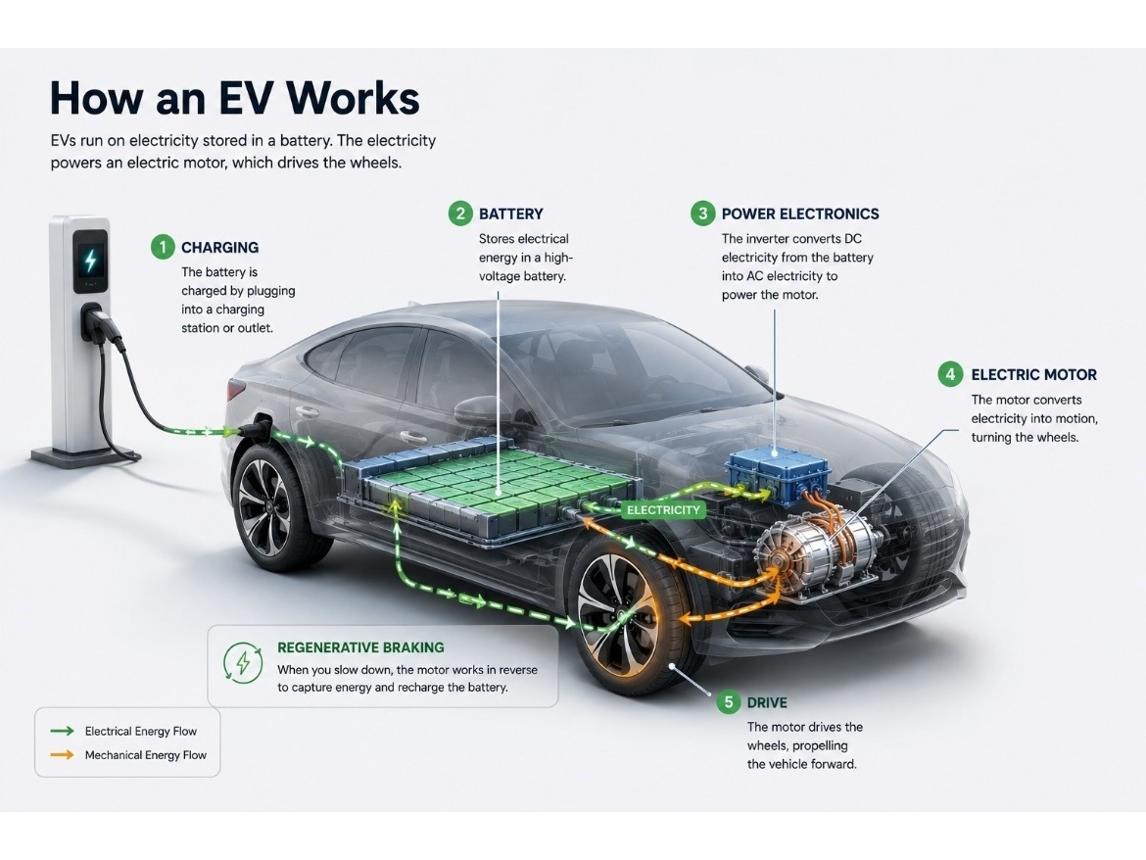
The working principle of an electric car is relatively straightforward. When you press the accelerator pedal, the vehicle’s electronic control system determines how much power is required. Electricity flows from the battery through the power electronics to the electric motor.
The motor converts electrical energy into mechanical energy, which drives the wheels through a transmission system. When the driver applies the brakes, regenerative braking can recover some of the vehicle’s kinetic energy and send it back to the battery.
The basic working sequence is:
- The battery stores electrical energy.
- The inverter controls electrical power supplied to the motor.
- The electric motor converts electrical energy into mechanical energy.
- The transmission transfers rotational power to the wheels.
- The wheels rotate and move the vehicle.
- During braking, regenerative braking can recover some energy and return it to the battery.
3. Major Components of an Electric Car
A. Battery Pack
The battery pack is one of the most important components of an electric vehicle. It stores the electrical energy required to operate the vehicle. Most modern electric cars use rechargeable lithium-ion battery technology.
The battery pack consists of individual cells connected together to form modules and larger battery assemblies.
When the vehicle is charging, electrical energy is stored through electrochemical reactions inside the battery cells. When the vehicle is moving, the battery releases electrical energy to power the electric motor and other electrical systems.
Battery capacity is measured in kilowatt-hours (kWh). For example, 40 kWh is a relatively small capacity, 60 kWh is medium-sized, 80 kWh is larger, and 100 kWh is a high-capacity battery. Generally, a larger battery can store more energy and potentially provide a longer driving range, although efficiency and vehicle design also matter.
B. Electric Motor
The electric motor converts electrical energy into mechanical energy to rotate the vehicle’s wheels. It performs a similar propulsion function to the internal combustion engine in a petrol vehicle, but it operates using electromagnetic principles rather than fuel combustion.
The main parts of a typical electric motor include:
- Stator: The stationary part that produces a rotating magnetic field.
- Rotor: The rotating part that responds to the magnetic field.
- Shaft: Transfers rotational motion to the drivetrain.
- Bearings: Support the rotating shaft and reduce friction.
When electrical current flows through the motor windings, magnetic fields are created. The interaction between these magnetic fields produces torque, causing the rotor to rotate. This rotational movement is transmitted through the drivetrain to turn the wheels.
Common electric motor technologies include Permanent Magnet Synchronous Motors (PMSM), AC Induction Motors and Switched Reluctance Motors. Electric motors can deliver strong torque from very low speeds, which is one reason many electric cars accelerate quickly.
C. Inverter
The inverter is an important power electronic component in an electric vehicle. Its primary function is to convert direct current (DC) electricity from the battery into alternating current (AC) for an AC traction motor.
Most high-voltage EV battery packs supply DC electricity, while many traction motors operate using AC electricity. The inverter makes this conversion possible.
It also controls the frequency and voltage supplied to the motor, allowing the vehicle to regulate motor speed and torque.
When the driver presses the accelerator, the vehicle’s control system sends a command to the inverter. The inverter adjusts the electrical power supplied to the motor, allowing the vehicle to accelerate or maintain its speed.
The inverter also plays an important role during regenerative braking, when electrical energy generated by the motor is converted into DC power for battery charging.
D. Transmission and Drivetrain
Electric cars still require a drivetrain to transfer mechanical power from the motor to the wheels. However, most fully electric passenger cars use a single-speed reduction gearbox rather than the multi-speed transmission commonly found in petrol vehicles.
The reduction gearbox reduces the motor’s high rotational speed while increasing the torque available at the wheels. Some electric vehicles use two-speed transmissions or more complex drivetrain arrangements, but single-speed systems are common.
E. Battery Management System (BMS)
The Battery Management System monitors and protects the battery pack. Its responsibilities include:
- Monitoring individual cell voltages.
- Measuring battery temperature.
- Monitoring charging and discharging current.
- Estimating the State of Charge (SOC).
- Estimating the State of Health (SOH).
- Protecting against overcharging and excessive discharge.
- Balancing battery cells.
Without an effective BMS, the battery could operate outside its safe limits, reducing its performance, lifespan and safety.
F. Onboard Charger
The onboard charger converts AC electricity from a home or public AC charging station into DC electricity suitable for charging the battery.
For DC fast charging, the external charging equipment performs the AC-to-DC conversion, so the battery receives DC power without using the onboard charger for that conversion. This is why DC fast chargers can generally provide much higher charging power than ordinary AC charging equipment.
4. What Is Regenerative Braking?
Regenerative braking is one of the most interesting technologies used in electric vehicles. In conventional vehicles, braking usually converts much of the vehicle’s kinetic energy into heat through friction between the brake pads and discs.
Electric vehicles can recover some of this energy. When the driver releases the accelerator or applies the brake, the electric motor can operate as a generator.
The process works as follows:
- The driver releases the accelerator or applies the brake.
- The moving wheels continue rotating the drivetrain.
- The motor operates as a generator.
- Mechanical energy is converted into electrical energy.
- The power electronics regulate the generated electricity.
- The recovered energy is sent back to the battery.
This process helps improve overall energy efficiency and can reduce the use of friction brakes. However, regenerative braking cannot recover all the energy lost during driving.
5. How Are Electric Cars Charged?
Electric vehicles need to be connected to an external electricity source to recharge their batteries. There are two major charging methods.
AC Charging
AC charging is commonly used at home and at many public charging stations. The vehicle’s onboard charger converts incoming AC electricity into DC electricity for the battery.
DC Fast Charging
DC fast charging supplies DC electricity directly to the vehicle’s high-voltage battery through the appropriate charging system. It is commonly used at public charging stations where drivers need to recharge more quickly.
The actual charging speed depends on the charger’s power, vehicle specifications, battery temperature and current battery charge level.
6. Electric Cars vs Petrol Cars: What Is the Difference?
| Feature | Electric car | Petrol car |
| Power source | Electricity | Petrol |
| Main propulsion unit | Electric motor | Combustion engine |
| Energy storage | Battery pack | Fuel tank |
| Energy conversion | Electromagnetic principles | Fuel combustion |
| Transmission | Usually single-speed | Usually multiple gears |
| Exhaust emissions | No tailpipe emissions | Produces exhaust emissions |
| Refuelling | Charging | Petrol station |
| Braking | Regenerative and friction braking | Primarily friction braking |
Both vehicle types perform the same basic function of transporting people and goods, but their powertrain technologies are very different.
7. Advantages of Electric Cars
Lower Running Costs: Electricity can cost less than petrol per kilometre or mile, depending on local electricity and fuel prices.
Reduced Maintenance: Electric vehicles generally have fewer moving parts in their propulsion systems. They do not require engine oil changes, spark plugs or exhaust system maintenance.
Instant Torque: Electric motors can deliver strong torque from low speeds, providing responsive acceleration.
No Tailpipe Emissions: Fully electric vehicles do not produce exhaust emissions while driving. However, electricity generation and battery manufacturing can still produce environmental emissions.
Quiet Operation: Electric motors operate more quietly than conventional internal combustion engines.
8. Disadvantages of Electric Cars
- Higher initial purchase prices for some models.
- Charging infrastructure may be limited in certain locations.
- Charging can take longer than refuelling with petrol.
- Driving range can decrease in cold weather.
- Battery replacement can be expensive.
- Battery production requires raw materials and energy.
As battery technology and charging infrastructure improve, some of these challenges are gradually being addressed.
9. What Happens When an Electric Car Runs Out of Battery?
When an electric car’s battery reaches its minimum usable charge, the vehicle can no longer provide normal propulsion. Depending on the model, the vehicle may display low-battery warnings, reduce available power and eventually stop.
The driver will need to arrange roadside assistance or charging. Unlike petrol vehicles, you cannot simply carry a small container of fuel to refill an EV. The vehicle needs an appropriate charging source.
This is why checking the remaining battery range before long journeys is important.
10. What Is the Future of Electric Vehicle Technology?
Electric vehicle technology continues to develop. Some of the major areas attracting investment and research include:
- Solid-state batteries.
- Faster DC charging technology.
- Improved battery energy density.
- More efficient electric motors.
- Vehicle-to-Grid (V2G) technology.
- Wireless EV charging.
- Advanced battery recycling.
- More affordable electric vehicles.
These developments could make electric vehicles more affordable, efficient and convenient in the coming years.
Frequently Asked Questions (FAQs)
Do electric cars have engines?
Electric cars have electric motors instead of conventional internal combustion engines. The motor converts electrical energy into mechanical energy to move the vehicle.
Do electric cars use petrol?
Fully electric vehicles (BEVs) do not use petrol for propulsion. They operate using electricity stored in rechargeable battery packs.
How does an electric car generate power?
An electric car does not generate its own primary energy. It stores electricity in its battery and uses an electric motor to convert that electrical energy into mechanical movement.
Why do electric cars not need many gears?
Electric motors provide useful torque across a wide speed range. This allows most electric passenger cars to operate efficiently with a single-speed reduction gearbox.
Can an electric car charge itself while driving?
An electric car can recover some energy through regenerative braking. However, this does not fully recharge the battery or eliminate the need for external charging.
How long does it take to charge an electric car?
Charging time depends on battery capacity, charging power, temperature and the vehicle’s charging limits. Home AC charging may take several hours, while compatible DC fast chargers can recharge a substantial portion of the battery much faster.
Conclusion
Electric cars work by combining battery technology, electric motors and power electronic systems to convert stored electrical energy into mechanical movement.
The battery supplies electricity, the inverter controls power delivery, the electric motor produces rotational motion, and the drivetrain transfers that motion to the wheels.
Regenerative braking adds another level of efficiency by recovering some of the energy normally lost during braking.
As battery technology, charging infrastructure and electric motor designs continue to improve, electric vehicles are becoming an increasingly important part of the global automotive industry.
Understanding how these systems work is the first step towards understanding the future of transportation.
Leave a Reply