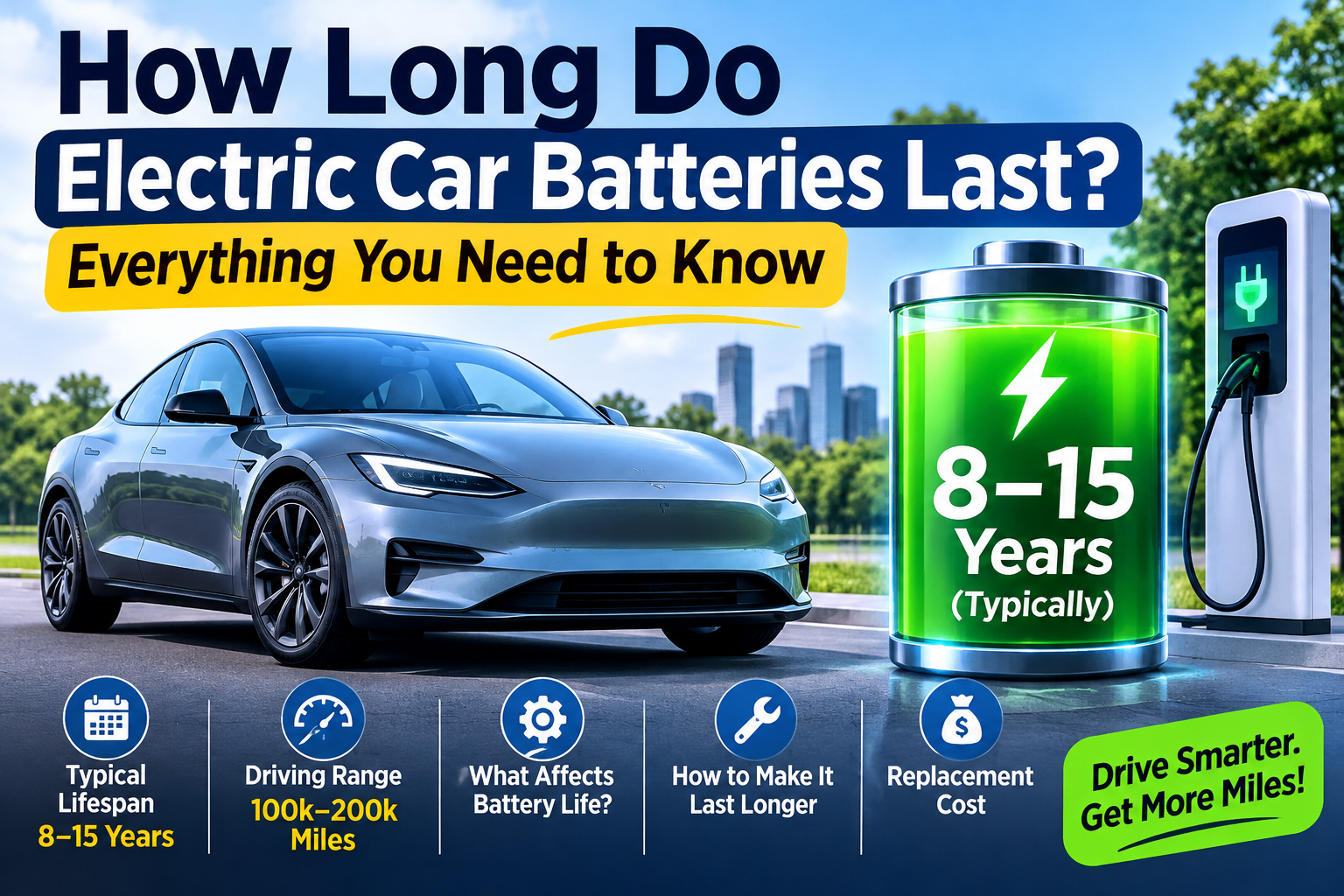
Electric vehicles (EVs) are becoming increasingly popular as drivers look for alternatives to traditional petrol and diesel cars. However, one question continues to concern potential buyers: How long do electric car batteries actually last?
Unlike conventional vehicles, which rely on internal combustion engines, electric cars use rechargeable battery packs to power their motors. These batteries are among the most expensive components of an EV, making their lifespan an important consideration when purchasing an electric vehicle.
The good news is that modern electric car batteries are designed to last for many years. With proper charging habits, suitable operating conditions and regular maintenance, some batteries can remain useful for 15 to 20 years or longer.
In this guide, we explain how long EV batteries last, what affects their lifespan, how much replacement costs, and what you can do to keep your battery in good condition.
How Long Do Electric Car Batteries Last?
Most modern electric vehicle batteries are designed to last approximately 12 to 15 years under moderate operating conditions. Some may last 20 years or longer, depending on the battery technology, vehicle model, climate and charging habits.
Battery lifespan is commonly measured in years, mileage or charging cycles. Many manufacturers provide battery warranties covering eight years or 100,000 miles, although coverage varies by manufacturer and model.
A warranty does not necessarily mean the battery will stop working after eight years. It simply provides a period during which the manufacturer offers protection against specified battery defects or excessive capacity loss.
Research published by Geotab in April 2026, based on data from more than 22,700 electric vehicles across 21 models, found an average annual battery degradation rate of approximately 2.3%.
This suggests that modern EV batteries can retain a substantial amount of their original capacity even after years of use.
What Happens to an Electric Car Battery Over Time?
Electric car batteries gradually lose their ability to store energy. This process is known as battery degradation.
When a battery is new, it can store close to its full designed capacity. However, repeated charging and discharging, temperature changes and chemical ageing gradually reduce the amount of energy it can hold.
For example, imagine an electric vehicle with a battery capacity of 60 kWh.
If the battery loses 10% of its original capacity, it will effectively hold approximately 54 kWh.
This does not mean the vehicle has stopped working. It simply means the driver may experience a shorter driving range than when the vehicle was new.
Battery degradation is a normal process and does not automatically mean that the battery needs replacement.
7 Factors That Affect Electric Car Battery Lifespan
Several factors determine how quickly an electric vehicle battery deteriorates.
1. Charging Habits
Charging habits play an important role in battery health.
Frequently keeping a battery at 100% charge or allowing it to remain almost empty for extended periods can increase battery stress.
Many EV manufacturers recommend charging to around 80% for everyday use, depending on the battery chemistry and vehicle manufacturer’s instructions.
Some vehicles also allow owners to set charging limits automatically.
2. Extreme Temperatures
High temperatures can accelerate chemical reactions inside lithium-ion batteries, contributing to faster degradation.
Cold weather can temporarily reduce battery performance and driving range. In some cases, prolonged exposure to extreme temperatures can also affect long-term battery health.
Modern electric vehicles often include thermal management systems designed to maintain suitable battery temperatures.
3. Frequent DC Fast Charging
DC fast charging allows drivers to recharge their vehicles much faster than conventional home charging.
However, regularly relying on high-power fast charging can increase battery degradation, particularly under high-temperature conditions.
Geotab’s 2026 battery health research found that vehicles frequently using high-power DC fast charging above 100 kW experienced higher degradation rates than those primarily using lower-power charging.
Fast charging remains useful for long journeys, but home or Level 2 charging is generally preferable for everyday use when practical.
4. Driving Habits
Aggressive acceleration, frequent high-speed driving and heavy loads can increase energy consumption and battery operating temperatures.
Driving smoothly, avoiding unnecessary acceleration and using regenerative braking appropriately can help improve efficiency.
5. Battery Chemistry
Not all electric car batteries are manufactured using the same chemistry.
Common battery technologies include:
- Lithium Iron Phosphate (LFP).
- Nickel Manganese Cobalt (NMC).
- Nickel Cobalt Aluminium (NCA).
Each chemistry has different characteristics involving energy density, charging behaviour, temperature tolerance and cycle life.
For example, LFP batteries are generally known for their durability and good cycle life, while NMC batteries offer higher energy density.
6. Battery Management System
An electric vehicle’s Battery Management System (BMS) monitors important battery parameters, including voltage, temperature, current and state of charge.
It helps protect battery cells against conditions such as overcharging, excessive discharge and overheating.
A well-designed battery management system contributes significantly to battery safety and long-term performance.
7. Vehicle Age and Usage
Battery degradation is influenced by both how frequently a vehicle is driven and how long its battery has been in service.
A vehicle that spends long periods exposed to extreme temperatures or at very high or very low charge levels may experience additional battery stress.
However, high mileage alone does not automatically mean an EV battery is in poor condition.
How Can You Make an Electric Car Battery Last Longer?
Although battery degradation cannot be completely prevented, there are practical ways to slow it down.
Here are some useful battery maintenance tips:
- Avoid keeping your battery at 100% charge for extended periods unless your vehicle manufacturer recommends it.
- Follow the manufacturer’s recommended daily charging limit.
- Avoid allowing the battery to remain nearly empty for long periods.
- Use home or Level 2 charging for regular charging when convenient.
- Limit unnecessary high-power DC fast charging.
- Park in shaded or temperature-controlled areas when possible.
- Avoid exposing your vehicle to extreme heat for extended periods.
- Follow recommended software updates and battery maintenance procedures.
These practices can help maintain battery health and preserve your vehicle’s driving range.
How Much Does It Cost to Replace an Electric Car Battery?
Electric vehicle battery replacement can be expensive because the battery pack is one of the vehicle’s most valuable components.
The actual replacement cost depends on several factors, including:
- Vehicle manufacturer and model.
- Battery capacity.
- Battery chemistry.
- Availability of replacement components.
- Labour and installation costs.
- Whether individual modules or the complete battery pack need replacement.
Some replacement jobs may cost several thousand dollars, while larger battery packs can cost considerably more.
However, complete battery replacement is not something every EV owner should automatically expect.
In many cases, batteries continue operating for years after their warranty expires. Some battery problems can also be addressed through repairs or module replacement, depending on the vehicle’s design and the manufacturer’s repair policy.
Before purchasing a used electric vehicle, it is advisable to request a battery health report and check whether the battery is still covered by its manufacturer’s warranty.
What Is the Average Warranty for an Electric Car Battery?
Many electric vehicle manufacturers offer battery warranties covering eight years or 100,000 miles, whichever comes first.
Some manufacturers provide longer warranties or higher mileage limits.
Battery warranties may also include a minimum capacity retention requirement. For example, some manufacturers guarantee that the battery will retain at least 70% of its original capacity during the warranty period.
However, warranty conditions differ between manufacturers, so buyers should carefully review the terms.
It is also important to understand that battery warranties do not necessarily cover every form of degradation or damage.
How Do You Know When an EV Battery Needs Replacement?
An electric vehicle battery does not necessarily need replacement simply because its driving range has decreased.
However, certain warning signs may indicate that the battery requires professional inspection.
These include:
- A significant and unexplained reduction in driving range.
- Battery warning messages on the dashboard.
- Unexpected charging interruptions.
- Unusual changes in battery performance.
- A battery health reading below the manufacturer’s recommended level.
If you notice any of these symptoms, have the vehicle inspected by a qualified EV technician.
A professional battery diagnostic test can help determine whether the problem involves normal degradation, a faulty battery module, the battery management system or another component.
Should You Buy a Used Electric Car With an Older Battery?
Buying a used electric vehicle can be a good way to save money, but battery condition should be one of your biggest considerations.
Before purchasing, consider the following:
- Check the battery’s State of Health (SOH).
- Review the vehicle’s charging history if available.
- Check the remaining battery warranty.
- Examine the vehicle’s actual driving range.
- Request a professional battery diagnostic report.
- Check for previous battery repairs or replacements.
A used electric vehicle with higher mileage can still be a good purchase if its battery remains in good condition.
Do not judge a used EV solely by its mileage or manufacturing year. Battery health provides a much clearer picture of its remaining energy storage capacity.
Frequently Asked Questions About Electric Car Batteries
1. Can an electric car battery last 20 years?
Yes. Some modern electric vehicle batteries may last 20 years or longer, depending on their chemistry, operating conditions and charging habits. However, actual lifespan varies between vehicles.
2. How many miles can an electric car battery last?
Many modern EV batteries are designed to operate for approximately 100,000 to 200,000 miles or more. Actual performance depends on the vehicle and how the battery is used.
3. Do electric car batteries need to be replaced?
Not necessarily. Many EV batteries remain functional throughout the useful life of their vehicles. Battery replacement is generally only necessary when the battery develops a serious fault or its remaining capacity becomes unsuitable for the owner’s needs.
4. Is it bad to charge an electric car every day?
No. Daily charging is generally safe when you follow the manufacturer’s recommended charging limits. You do not need to wait until the battery is completely empty before charging.
5. Does fast charging damage electric car batteries?
Frequent high-power DC fast charging can increase battery degradation, particularly in hot conditions. However, occasional fast charging is a normal part of EV ownership.
6. Can an electric car battery be repaired?
Yes, depending on the vehicle and the nature of the problem. Some battery packs allow individual modules or components to be repaired or replaced instead of replacing the entire pack.
Conclusion
Electric car batteries are becoming more durable as battery chemistry, thermal management and battery management technology continue to improve.
Although battery degradation is unavoidable, modern EV batteries can last for many years and potentially outlast the useful life of the vehicle.
For anyone considering an electric vehicle, battery lifespan should not be the only factor when making a purchasing decision. Charging infrastructure, driving range, warranty coverage, maintenance costs and battery health are equally important.
By following good charging practices and maintaining the vehicle properly, drivers can get more years of reliable performance from their electric car batteries.
Ultimately, understanding how EV batteries work and how to care for them can help you make a more informed decision when buying or owning an electric vehicle.
Leave a Reply